Preventing Falls in Elderly at Home: A Room-by-Room Guide
Falls are the leading cause of avoidable injury in the elderly. Here's how Kolkata families can reduce risk without turning the home into a hospital ward.
Why falls matter more than any family realises
In healthy adults, a slip on a wet floor is an inconvenience. In an elderly parent, the same slip can end mobility, independence, and — heartbreakingly often — life itself. The Indian Council of Medical Research consistently lists falls as one of the top three causes of preventable death in patients above 65. What makes them especially cruel is that most of them happen not in slippery hospital corridors, but at home — in bathrooms, on staircases, on well-loved rugs.
The good news is that fall risk is almost entirely modifiable. A single afternoon of thoughtful auditing can dramatically reduce the odds. This guide takes you room by room.
Understanding why elderly people fall
Falls in the elderly rarely happen because someone was careless. They happen because of a combination of small factors — reduced strength, slower reflexes, medication side-effects, poor vision, low blood pressure on standing (postural hypotension), and an environment that is subtly hostile to their limitations.
Common triggers:
- Postural hypotension — standing up quickly causes blood pressure to drop, leading to a moment of dizziness.
- Vision changes — cataracts, poorly-adjusted spectacles, low light.
- Medication side-effects — sleeping pills, some blood pressure medications, and antidepressants all increase fall risk.
- Muscle weakness — particularly in the hips and thighs, which develops silently after age 65.
- Poor foot health — long toenails, ill-fitting shoes, or slippers without grip.
Understanding these gives you a lens through which to look at every room in the house.
The bathroom — where most falls happen
Statistically, the single most dangerous room in an elderly Indian home is the bathroom. Wet floors, hard tiles, cramped space, and awkward transfers make it a perfect storm.
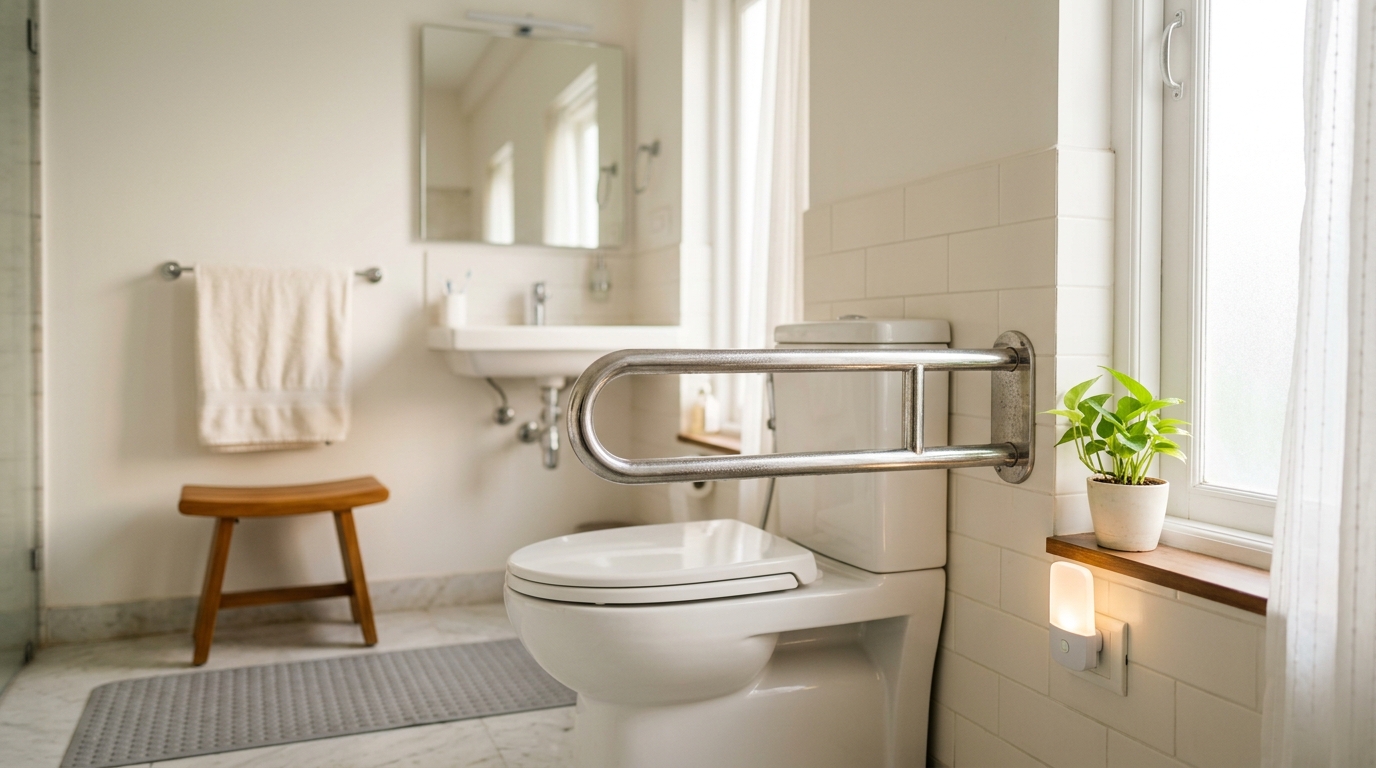
- Install grab bars — one beside the toilet, one in the shower area. Suction-cup versions are inadequate; they must be drilled into the wall. Cost: ₹300–800 per bar; installation ₹200. Well worth it.
- Anti-slip mats — inside the bathing area and on the floor outside. Replace when they lose grip.
- A shower chair or stool — allows bathing while seated. Reduces both fall risk and exhaustion.
- A raised toilet seat — for elderly with knee or hip issues, adds 4–6 inches of height, making sit-and-stand easier.
- Adequate lighting — soft, even light. A cold bathroom light at 2 am is a fall risk in itself.
- Emergency access — either the bathroom door should be openable from outside in emergency, or a phone/bell must be within reach.
If the bathroom is on a different floor, that's a red flag that deserves conversation with the family.
The bedroom
The path from bed to bathroom at night is the second most common fall site.
- Bedside lamp with easy switch — reachable without leaning far.
- Motion-sensor night lights — plug into wall sockets along the path.
- Firm mattress — an old, soft mattress makes getting up harder.
- Bed height — feet should touch the floor when sitting on the edge. Too high or too low, both are risks.
- Slippers with grip — kept at the same spot near the bed.
- Clear pathway — no laundry baskets, cables, or low furniture in the walking path.
- Water and medication tray within reach — reduces night walks.
For patients with cognitive issues (early dementia, sundowning), a small bell or motion sensor on the door alerts a family member if they wander at night.
Stairs and landings
For homes with staircases:
- Handrails on both sides — especially important for older patients with weakness on one side.
- Non-slip tread strips — inexpensive and highly effective.
- Adequate lighting at the top and bottom — a common fall pattern is misjudging the last step.
- Consider avoiding stairs entirely if the patient has had a fall in the past year. A ground-floor sleeping arrangement is often the right compromise.
The living areas
- Remove loose rugs — the single biggest offender. If a rug is beloved, secure it with double-sided tape or replace with an anti-slip backed rug.
- Furniture layout — clear pathways at least 90 cm wide.
- Sturdy chairs with armrests — for both sitting and standing up. Low, soft sofas are exhausting for the elderly.
- Cable management — no phone chargers, TV wires, or fan cables across walking paths.
- Slippery floor polish — reconsider; matte finishes are safer.
Medication review — the invisible fall risk
Many families are surprised to learn that medications cause more falls than environments. Common culprits:
- Sleeping pills and sedatives
- Some blood pressure medications (especially at higher doses)
- Antidepressants and anti-anxiety medications
- Certain diabetes medications that can cause blood sugar dips
- Combinations of the above ("polypharmacy")
Any elderly patient on more than 4 daily medications should have a medication review with their doctor at least once a year. Ask specifically: "Which of these could increase fall risk, and can any be tapered or replaced?"
Vision and hearing
- Annual eye check — cataracts and macular degeneration are treatable.
- Spectacle prescription review — bifocals and progressive lenses can cause depth-perception issues on stairs. Single-vision distance glasses for walking may be safer.
- Hearing aids — hearing loss increases fall risk indirectly (through reduced spatial awareness and balance).
Strength — the intervention that quietly transforms
The most effective fall prevention isn't a grab bar. It's a slightly stronger set of legs.
Fifteen minutes of daily light exercise — sit-to-stand practice, standing on one leg with support, simple heel raises, and short walks — dramatically improves balance and lower-body strength in the elderly. A home physiotherapist can design a routine in a single visit that the family (or attendant) then supervises daily.
At Suraksha Care, we integrate a short balance-and-strength routine into every elderly attendant's daily schedule. It's not gym-intensive; it's kitchen-side exercises that fit into ordinary life.
After a fall — the critical 24 hours
If your parent has fallen, even without visible injury:
- Do a slow, careful head-to-toe check. Hip and rib fractures can be subtle.
- Any confusion, drowsiness, or new headache in the following 24 hours warrants a medical review — silent brain bleeds are more common in elderly and in patients on blood thinners.
- The psychological impact is real: fear of falling often causes reduced activity, which further weakens muscles, which increases future fall risk. Address the fear directly with reassurance and support.
- Ask the doctor for a formal falls-risk assessment.
The Suraksha approach
Every elderly-care engagement at Suraksha Care begins with a home safety review — bathrooms, bedroom, stairs, medication list, mobility assessment. Our Care Coordinator makes recommendations, our attendants integrate balance exercises into daily care, and our nurses coordinate medication reviews with your treating physician.
You don't have to convert the home into a hospital. You have to make it just a little kinder to the person who has lived in it for decades.
Medical disclaimer: This article is general guidance. Please consult your treating physician for advice specific to your family's situation.
Frequently asked questions
My parent already had a fall — what should we do first?
Are grab bars really worth installing?
Can medications really cause falls?
Do you provide fall-prevention home audits?
Need professional home healthcare?
Get the right caregiver for your family — in under 15 minutes.
Our Care Coordinators are available 24×7 across Kolkata. No obligation, no waiting.