Setting Up ICU at Home in Kolkata: A Family's Complete Guide
When is ICU-at-home the right choice, what equipment and staffing does it involve, how much does it cost, and what should families expect?
When ICU-at-home is the right choice
Not every critical patient needs to remain in a hospital ICU. For many families, once the acute phase has passed and the treating physician is comfortable with the patient's stability, continuing intensive care at home is medically appropriate — and often significantly better for the patient.
Reasons families choose ICU-at-home in Kolkata:
- **Extended hospital ICU stays** are financially and emotionally exhausting. A hospital ICU bed in Kolkata typically costs ₹25,000–45,000 per day. ICU-at-home is a fraction of that.
- **Hospital-acquired infections** — the longer a patient stays in an ICU, the higher the risk of ventilator-associated pneumonia and multi-drug-resistant infections.
- **Family presence** — being at home, with familiar sounds and family within reach, is measurably better for recovery.
- **Chronic care** — for patients with long-term ventilator dependency, dialysis, or complex nursing needs that would otherwise occupy an ICU bed indefinitely.
- **End-of-life care** — many families rightly want their loved one's final weeks to be at home rather than in a clinical setting.
What ICU-at-home actually involves
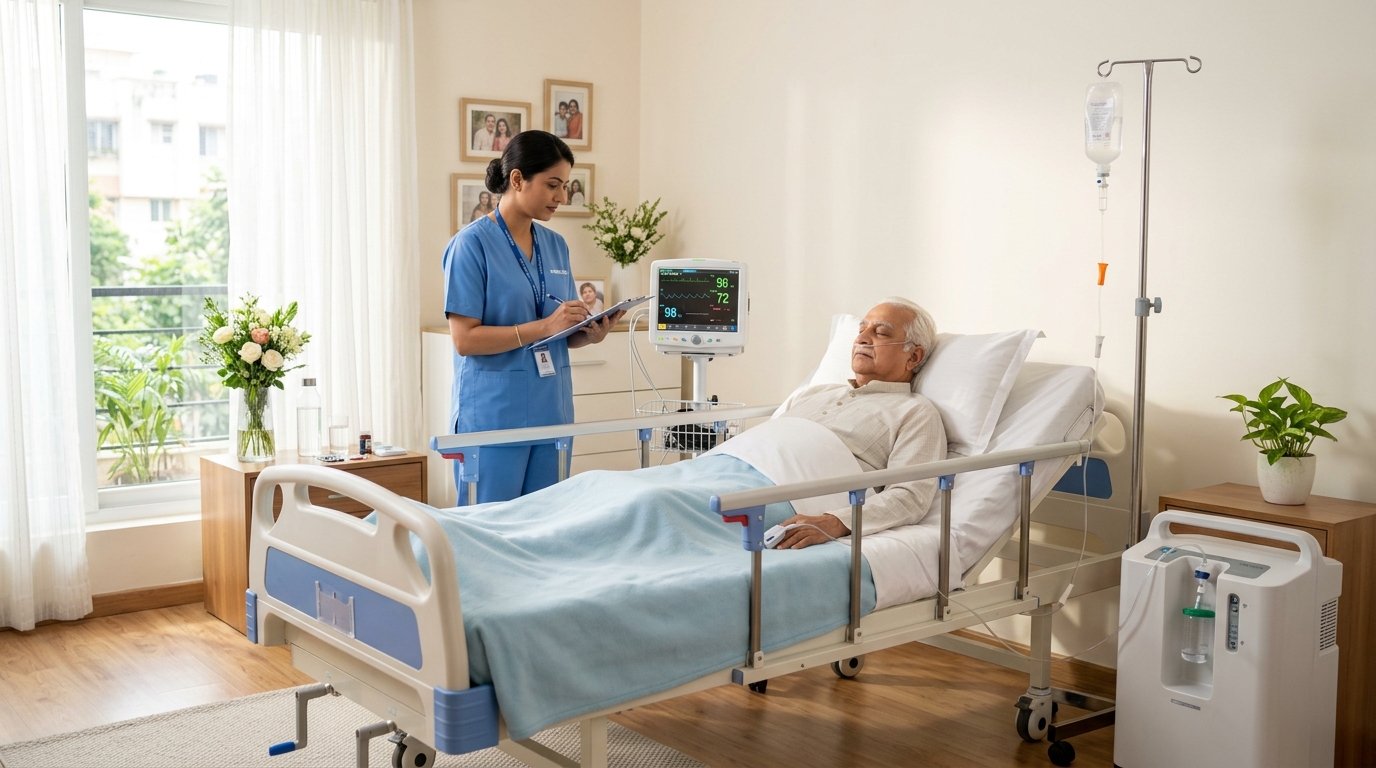
An ICU-at-home setup replicates the essential clinical capabilities of a hospital ICU within a patient's bedroom. The specifics vary by case, but a typical setup includes:
Equipment
- **Hospital bed** — semi-electric with side rails, adjustable head and knee.
- **Multi-parameter monitor** — displays heart rate, oxygen saturation, blood pressure, respiratory rate, and body temperature.
- **Oxygen concentrator** (5–10 LPM) — for continuous oxygen support; often with a backup cylinder.
- **Suction machine** — for clearing respiratory secretions.
- **Ventilator** (if required) — home-use ventilators for tracheostomy patients or those with respiratory failure.
- **Nebulizer**, **BiPAP/CPAP** (if prescribed).
- **Infusion pumps** — for continuous IV medication or feeding.
- **Ryles tube / PEG feeding** — supplies and formulas.
- **Wound care and dressing supplies**, catheters, and consumables.
Staffing
- **ICU-trained nurse** — 24-hour cover with two nurses rotating on 12-hour shifts. These are BSc / GNM nurses with specific ICU experience (ventilator management, tracheostomy care, IV inotropes, arterial line management if needed).
- **Attendant** — sometimes added for basic hygiene and turning if the patient is bed-bound.
- **Physiotherapist** — for chest physiotherapy and passive range-of-motion exercises, usually daily.
- **Doctor coordination** — a home-visit doctor or telephonic coordination with the treating consultant, weekly reviews.
Emergency protocols
- Clear escalation plan if vitals deteriorate.
- Nearest hospital and route pre-mapped.
- 24×7 Care Coordinator on call.
- Family briefed on when to call 108 vs. Suraksha vs. the treating doctor.
The typical patient profile
At Suraksha Care, most of our ICU-at-home patients fall into one of these groups:
- **Advanced neuro patients** — post-stroke with reduced consciousness, motor neuron disease, advanced dementia complications.
- **Chronic respiratory failure** — COPD end-stage, post-tuberculosis lung damage, ventilator-dependent patients.
- **Cardiac patients** — heart failure with frequent decompensation, post-cardiac surgery complex recovery.
- **Advanced cancer** — patients requiring symptom control and palliative-intensive nursing.
- **Post-major-surgery** — very rarely, when the doctor supports early home discharge into an ICU-equivalent home setup.
Setting it up — the first 24 hours
The hardest part of ICU-at-home is the initial setup. At Suraksha Care, we typically manage this in a coordinated sequence:
- **Doctor's discharge summary** shared with our Coordinator, ideally 24 hours before planned discharge.
- **Home visit / video walkthrough** by our team to plan the bedroom setup — bed placement, power sockets, water access, ventilation.
- **Equipment delivery and installation** by our technicians — typically 4–6 hours of work.
- **ICU-trained nurse** arrives at the same time as the patient (or before, if hospital-to-home transport is by ambulance).
- **Doctor briefing** — the treating consultant is put in touch with our nurse for direct handover of the care plan.
- **Family orientation** — what to expect, what alarms mean, when to call whom.
The goal is that the transition from hospital to home is medically seamless. Nothing is left to guesswork.
Cost — what to expect
ICU-at-home in Kolkata typically costs between ₹80,000 and ₹1,50,000 per month, depending on:
- Whether a ventilator is required.
- Whether one nurse per shift is sufficient, or two are needed simultaneously.
- Equipment rentals (bed, oxygen, monitor, ventilator, infusion pumps).
- Consumables (dressings, catheters, feeds, tracheostomy tubes).
- Doctor visits.
Compared to hospital ICU (₹8–15 lakh per month), the cost savings are substantial. But more than the cost, families report that quality of life for the patient — and their own emotional endurance — improves dramatically.
What families should watch for
A well-run ICU-at-home is characterised by:
- **Documented vitals** every 2–4 hours (or per protocol).
- **Daily nursing notes** shared with the treating doctor.
- **Alert nursing team** that catches subtle changes early.
- **Zero infection outbreaks** — hand hygiene, sterile technique, and equipment cleaning are non-negotiable.
- **Family updates** — even for patients who can't communicate, families are kept informed about progress or concerns.
Red flags to escalate immediately:
- Nurse fatigue (a nurse working double shifts is unsafe).
- Reused disposables.
- No documented vitals.
- Delayed medication or nebulisation.
- Missed doctor's schedule.
If you're evaluating providers, ask specifically about handover protocols between shifts, equipment maintenance schedules, and how emergency escalation is handled at 3 am on a Sunday.
The Suraksha Care difference
Every Suraksha Care ICU-at-home engagement includes:
- **ICU-trained nurses** with documented ventilator, tracheostomy and IV inotrope experience.
- **24-hour Coordinator access** — the family always has a senior contact.
- **Equipment maintenance guarantee** — critical equipment replaced within 2–4 hours in central and south Kolkata.
- **Direct coordination with the treating consultant** at AMRI, RN Tagore, Peerless, Fortis, Ruby, Belle Vue and other Kolkata hospitals.
- **Written care plan reviewed weekly**.
If you're facing a decision about extending ICU stay or moving to home-based intensive care, our Coordinator can talk you through the specifics — including what your treating doctor's opinion should be.
Medical disclaimer: ICU-at-home is medically complex and always requires the treating physician's approval. This article is general guidance; final decisions must involve the doctor overseeing the patient's care.
Need professional home healthcare?
Get the right caregiver for your family — in under 15 minutes.
Our Care Coordinators are available 24×7 across Kolkata. No obligation, no waiting.